
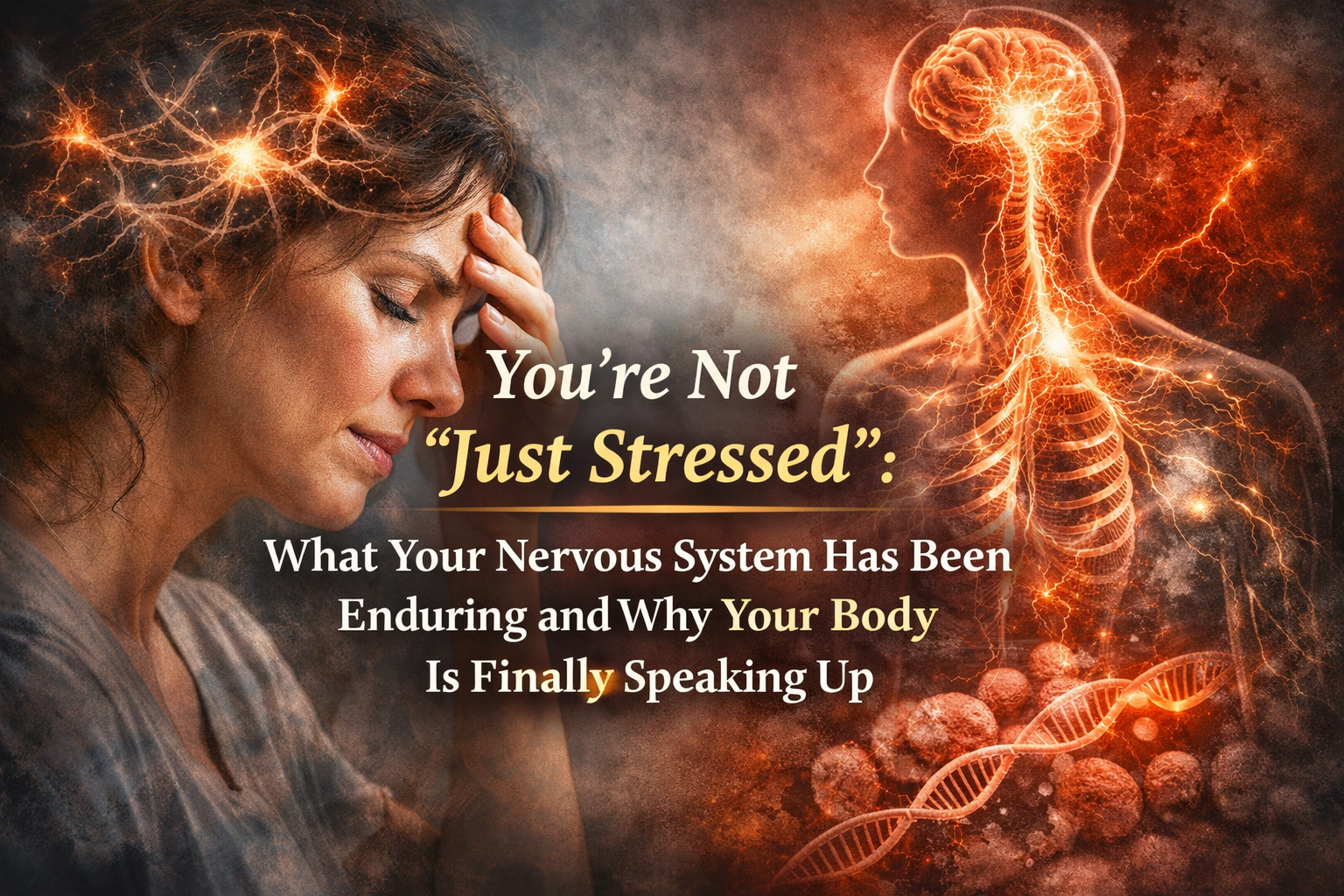
You’re Not “Just Stressed”: What Your Nervous System Has Been Enduring
Something is wrong. Has been wrong for a long time. Sublet at first, maybe a bad night’s sleep or a hangover or dinner didn’t agree with you—not feeling great but can explain it away. But then the feeling persists. More fatigue, difficulty getting out of bed, why do I keep forgetting everything?? Neck aches, a lingering headache that keeps coming back. Nausea. Something feels definitely wrong—is it my thyroid? Is that why I put on more weight?
After months of nagging symptoms and worry that something is seriously wrong, you finally bring yourself to the doctor. They run tests. You anxiously await the results. It’s gotta be my thyroid, you say to yourself after pouring through the internet looking at people with similar symptoms. If not my thyroid for sure a hormonal imbalance. And then the call, “your labs came back normal, everything looks good. Except your cholesterol, that is pretty high. We can keep an eye on it or we can put you on a statin now and get ahead of it…” Something along those lines. Seriously?
And then the words we have all heard before—by every practitioner and second opinion you get—“it’s just stress. You need to cut stress out of your life.” What does that even mean?? I’m telling you that something is very wrong, I’m not sleeping well, I’ve gained weight, I’m so tired, I can’t think straight, my stomach hurts, my hair is dry and thinning, I don’t feel like myself anymore! And there is NO new stress in my life, so why on earth would I feel like this? What am I supposed to do, sell the children, quit my job and live on the beach for the rest of my life?”
Here’s the thing, stress doesn’t mean what we have been taught it means.
What Stress Really Means in the Body
When we use the word stress in the clinic, we are not talking about a vague emotional state or a personality flaw. We are not saying you are stressed because you are doing something wrong, thinking incorrectly, or failing to cope. We are not asking you to simply “relax,” change your mindset, or add one more thing to your to-do list in the form of yoga or meditation. When we talk about stress, we are talking about your nervous system. We are talking about what your body has lived through, adapted to, and endured in a culture that rarely allows true rest, rhythm, or recovery.
Stress has become such an overused word that it has lost its weight. It gets tossed around casually, flattened into meaninglessness. But inside the body, stress is anything but vague. It is a biological state. It is electrical, chemical, hormonal. It is the way your nervous system has learned to survive in a world that demands constant output, constant alertness, constant productivity, and constant availability. It is the cost of living in a go-go-go society that celebrates busyness as virtue and treats exhaustion as normal.
The Sympathetic and Parasympathetic Nervous System Explained
At the center of this conversation is the autonomic nervous system, which quietly governs your internal world without asking permission. This system has two primary modes. One is the sympathetic nervous system, often described as fight or flight. This is the state that mobilizes you. It sharpens your senses, tightens your muscles, raises your heart rate, increases blood sugar, and floods your system with stress hormones like cortisol and adrenaline so you can respond to perceived threats.
The other is the parasympathetic nervous system, sometimes called rest and digest. This is the state that allows your body to soften. Digestion improves. Hormones regulate. Inflammation quiets. Tissue repairs. Immune function strengthens. You feel safe enough to rest, to connect, to feel pleasure, to heal.
In a healthy, natural environment, these two states ebb and flow. Activation is followed by recovery. Effort is followed by rest. The problem is that for many people, especially in modern life, the off switch has stopped working. The sympathetic nervous system stays engaged long after the threat has passed, or worse, never fully shuts off at all. Traffic, emails, deadlines, financial pressure, caregiving, lack of sleep, constant noise, social media, unresolved trauma, chronic illness, and even subtle emotional strain all register in the body as stressors. Your nervous system does not differentiate between a predator and a calendar full of obligations. It only knows whether it feels safe or under threat.
How Chronic Stress Affects Hormones, Inflammation, and Cells
When the body remains in a prolonged stress response, the internal environment begins to change. Cortisol, meant to rise and fall in a daily rhythm, stays elevated or becomes erratic. Blood sugar regulation becomes unstable. Inflammatory pathways stay switched on. Mitochondria, the energy-producing structures inside your cells, begin to struggle under oxidative stress. Free radicals accumulate faster than the body can neutralize them, leading to microscopic damage to tissues, nerves, and connective structures. Over time, this oxidative load contributes to pain, fatigue, brain fog, hormonal imbalance, immune dysfunction, and accelerated aging.
This internal chaos does not stay invisible. It shows up in the body in very real, physical ways. Muscles tighten and stay tight. Fascia becomes rigid and less responsive. Digestion slows or becomes irritated. Sleep becomes shallow or fragmented. Hormones lose their smooth communication with the brain. You may wake up already tired, your jaw clenched, your shoulders lifted toward your ears, your mind racing before your feet even touch the floor.
Why Stress Feels Different in Your 40s (Especially for Women)
For many women entering their 40s, this is when the cost of long-term nervous system overload becomes impossible to ignore. Estrogen and progesterone, hormones that once buffered stress and supported mood, sleep, and tissue repair, begin to fluctuate and decline. The nervous system becomes more sensitive. The same level of stress that once felt manageable now feels overwhelming. Women describe waking up with a sense of heaviness or flatness, a loss of joy that feels unfamiliar and unsettling. Touch can feel irritating rather than comforting. Patience wears thin. Anxiety hums quietly in the background. Motivation fades. The body feels foreign, reactive, and unpredictable. This is not weakness. It is physiology.
How Nervous System Overload Shows Up in Men
Men experience this overload differently, but no less profoundly. Chronic stress often shows up as irritability, restlessness, dissatisfaction, and a short fuse. Headaches, neck tension, low back pain, digestive issues, and sleep disturbances become common companions. Emotional fatigue may express itself as withdrawal or numbness rather than sadness. The body holds the story even when words are scarce. Pain becomes the language.
Why Acupuncture, Yoga, Massage, and Sauna Work Together
What all of these experiences have in common is a nervous system that has been asked to do too much for too long. When we say your symptoms are connected to stress, we are naming this reality. We are acknowledging that your body has been living in a state of protection, bracing itself against a world that rarely slows down. Your symptoms are not random. They are signals. They are the body’s attempt to adapt, compensate, and survive.
This is why the therapies we offer are not indulgences or luxuries. They are not quick fixes or surface-level self-care. Acupuncture, yoga, sauna, and massage all work directly with the nervous system, each in its own way, and their power is magnified when they are combined and repeated over time.
Acupuncture communicates with the nervous system through precise sensory input, helping shift the body out of fight or flight and into a state where healing becomes possible. It influences hormone regulation, reduces inflammatory signaling, improves circulation, and calms hypervigilant neural pathways.
Yoga, when practiced with intention, restores proprioception and breath awareness, reminding the nervous system that it is safe to inhabit the body again. Sauna supports detoxification, increases circulation, and creates a controlled stress that paradoxically teaches the nervous system how to recover more efficiently. Massage addresses the physical holding patterns created by chronic stress, softening tissues that have forgotten how to let go and sending powerful signals of safety through touch.
Over time, these therapies retrain the nervous system. They restore rhythm. They rebuild resilience. They help the body remember how to move between activation and rest without getting stuck. Healing does not happen all at once. It happens gradually, through repetition, consistency, and support. The nervous system learns through experience, not logic.
When we talk about stress in the clinic, we are honoring the intelligence of your body. We are recognizing that your symptoms make sense in the context of your life. And we are offering real, tangible ways to help your system come back into balance. This is not about doing more. It is about creating the conditions where your body can finally exhale.
Call our office today or book online to see how we can help you recover.
To learn more about how the brain and nervous system respond to stress, click here and here for in-depth explanations from Harvard Health.